Agent Systems
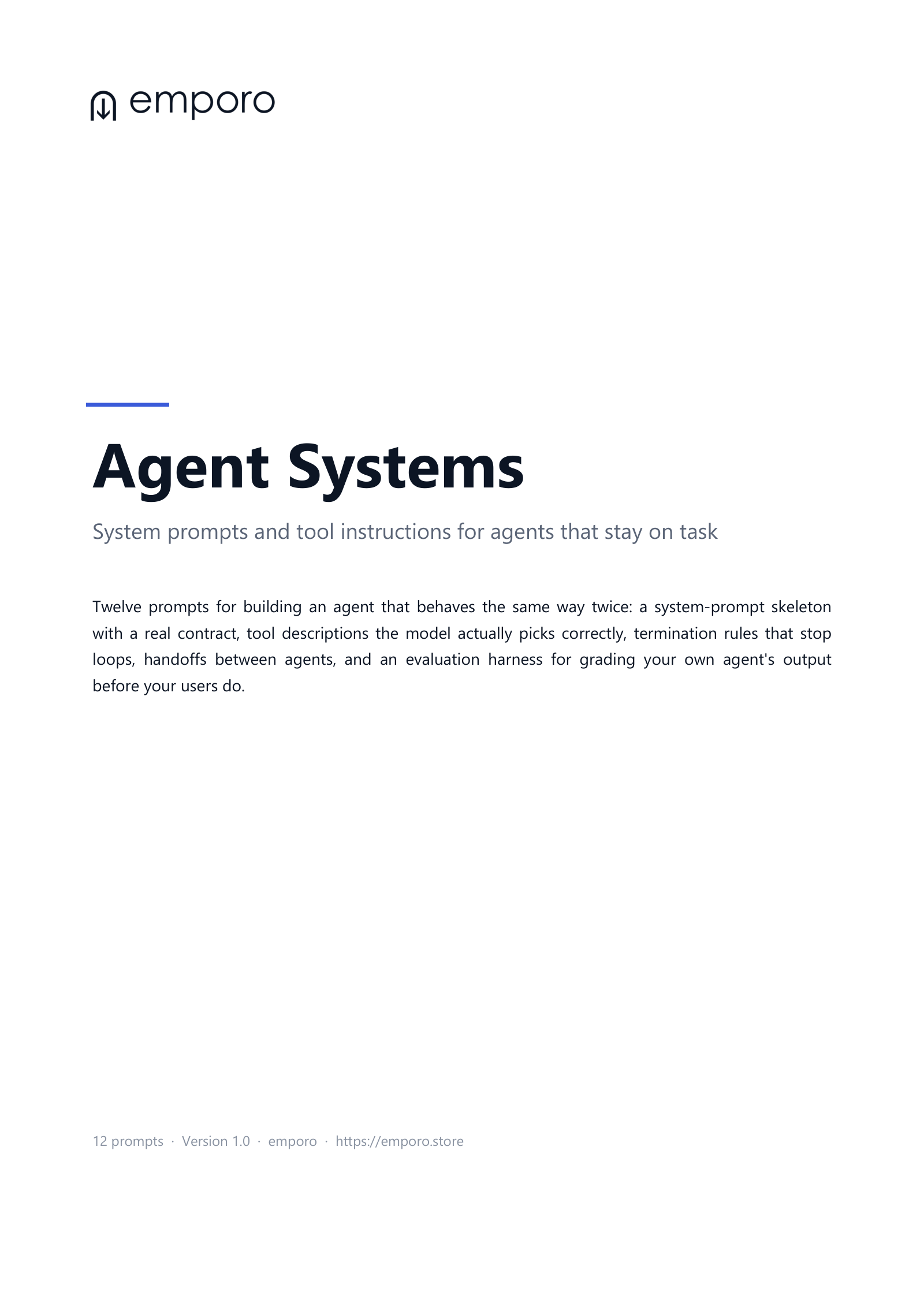
An agent that makes the same decision on the same ticket twice, and stops when it should.
Rs. 1,499.00was Rs. 2,999.00
12 prompts → Rs. 124.9 per prompt · one-time · yours
UPI · card · netbanking · link in seconds
- UPI · cards · netbanking via Razorpay and Shopify Secure checkout
- Your download link appears the moment the payment clears
- Link resent free if it ever fails
- Preview before you pay: 3 PDF pages, one full prompt, the file list
- Built from Anthropic's published guidance for Fable 5.1 — every word ours
v1.0 · 2026-09-02 31 files 195 KB
- Format
- PDF + Markdown + plain text
- Prompts
- 12 prompts
- Outcome
- Agents that stay on task
Instant download. One-time payment. No account needed.
The model
Claude Fable 5.1 is Anthropic's newest and most capable generally available model (released September 2026). Every prompt in this pack was written by it.
This pack makes ChatGPT, Gemini, Claude and the open models you run work like it: look first, finish the task, verify, report. It does not make them Fable — it makes them work the way Fable works.
v1.0 · written by Fable 5.1
01What Rs. 1,499 buys
Everything in the zip, counted.
- 12
- prompts, each in its own file
- 31
- files in the zip
- 4
- adaptersOpenAI, Gemini, Claude, Frameworks
- v1.x
- free updates for the same version, at the same link
- 1 licence
- personal and client work, commercial included
Why this is not a free prompt
Every prompt was run against four models — ChatGPT, Gemini, Claude and an open model — and the adapters record what each one does with it. Every line was written from Anthropic's published guidance for Fable 5.1, not collected from a prompt list. Each prompt file carries what-it-fixes and what-to-change notes, so you adapt it to your case instead of guessing.

02What's inside
Agent Systems contains
- A system prompt skeleton: role, scope, refusal rules, output contract
- Tool descriptions written so the model picks the right one
- Termination conditions that stop an agent looping
- A state and memory pattern for multi-step runs
- 6 handoff prompts for agents that call other agents
- An evaluation harness prompt for grading your own agent's output
- Failure-mode notes: what to add the first time it goes off task
Inside the zip
- README.md 1.6 KB
- agent-systems.pdf 185.9 KB
- before-after.md 1.1 KB
adapters/ 4 files
- claude.md 0.6 KB
- frameworks.md 0.6 KB
- gemini.md 0.5 KB
- openai.md 0.7 KB
prompts/ 24 files
- 01-skeleton.md 1.9 KB
- 01-skeleton.txt 1.3 KB
- 02-scope-rules.md 1.5 KB
- 02-scope-rules.txt 0.9 KB
- 03-tool-descriptions.md 1.5 KB
- 03-tool-descriptions.txt 1.0 KB
- 04-output-contract.md 1.6 KB
- 04-output-contract.txt 1.1 KB
- 05-termination.md 1.8 KB
- 05-termination.txt 1.3 KB
- 06-state-memory.md 1.6 KB
- 06-state-memory.txt 1.1 KB
- 07-handoff-orchestrator-to-worker.md 1.4 KB
- 07-handoff-orchestrator-to-worker.txt 0.8 KB
- 08-handoff-worker-to-orchestrator.md 1.3 KB
- 08-handoff-worker-to-orchestrator.txt 0.8 KB
- 09-handoff-escalate-to-human.md 1.4 KB
- 09-handoff-escalate-to-human.txt 0.9 KB
- 10-self-check.md 1.4 KB
- 10-self-check.txt 0.9 KB
- 11-eval-harness.md 1.7 KB
- 11-eval-harness.txt 1.3 KB
- 12-failure-modes.md 1.9 KB
- 12-failure-modes.txt 1.4 KB
For
- Developers building on Claude, GPT or Gemini APIs
- Anyone shipping an assistant that has to behave the same way twice
- Teams whose agent works in testing and wanders in production
Not for
- People looking for no-code automation templates
- Anyone who has not decided what the agent is for
03Where it goes
Paste it where your model reads instructions.

Where to put it
- The skeleton (01) is the instructions / system message. Tool descriptions (03) go in the function description fields; the DO NOT USE WHEN lines belong there, not in the system prompt.
- Enforce the output contract (04) with structured outputs / a JSON schema where the model supports it; the prompt sets the shape, the schema guarantees it.
- GPT models are eager to declare success. Keep the SUCCESS condition concrete and add the "a call returning without error is not success" line.
Where to put it
- The skeleton goes in systemInstruction. Gemini follows numbered rules more reliably than prose; keep the skeleton's lists as lists.
- Gemini adds preambles to structured output. Add "Return only the object, no text before or after" to the output contract binding sentence and validate in code.
- Function-calling descriptions matter as much as on other models; the pairwise "which sentence tells them apart" output of prompt 03 is worth doing here.
Where to put it
- The skeleton goes in system. Claude follows long system prompts reliably; put SCOPE and MUST NEVER DO first regardless.
- Tool descriptions live in the tool definition's description; Claude reads them closely, so the USE WHEN / DO NOT USE WHEN split matters most here.
- Use the effort parameter to steer depth per task; keep it high for the eval harness (11) and lower for routine tool loops.
- Keep conversation history append-only; newer Claude models invalidate their thinking when earlier turns are edited. Send per-turn reminders as fresh messages.
Where to put it
- Frameworks add their own wrapper prompts around yours. Read what they inject; it can contradict your SCOPE or TONE. Where you can, replace the framework's default agent prompt with the skeleton.
- Termination (05) must be enforced in code as well as in the prompt — a max-iterations setting is the BUDGET rule made real.
- The STATE block (06) maps to whatever scratchpad the framework exposes; if it has none, keep the block in the message history explicitly.
- Log briefs (07) and returns (08) as structured records. When an agent chain fails, those two logs are the whole debugging story.
04Try one free
Try one of them before you buy.
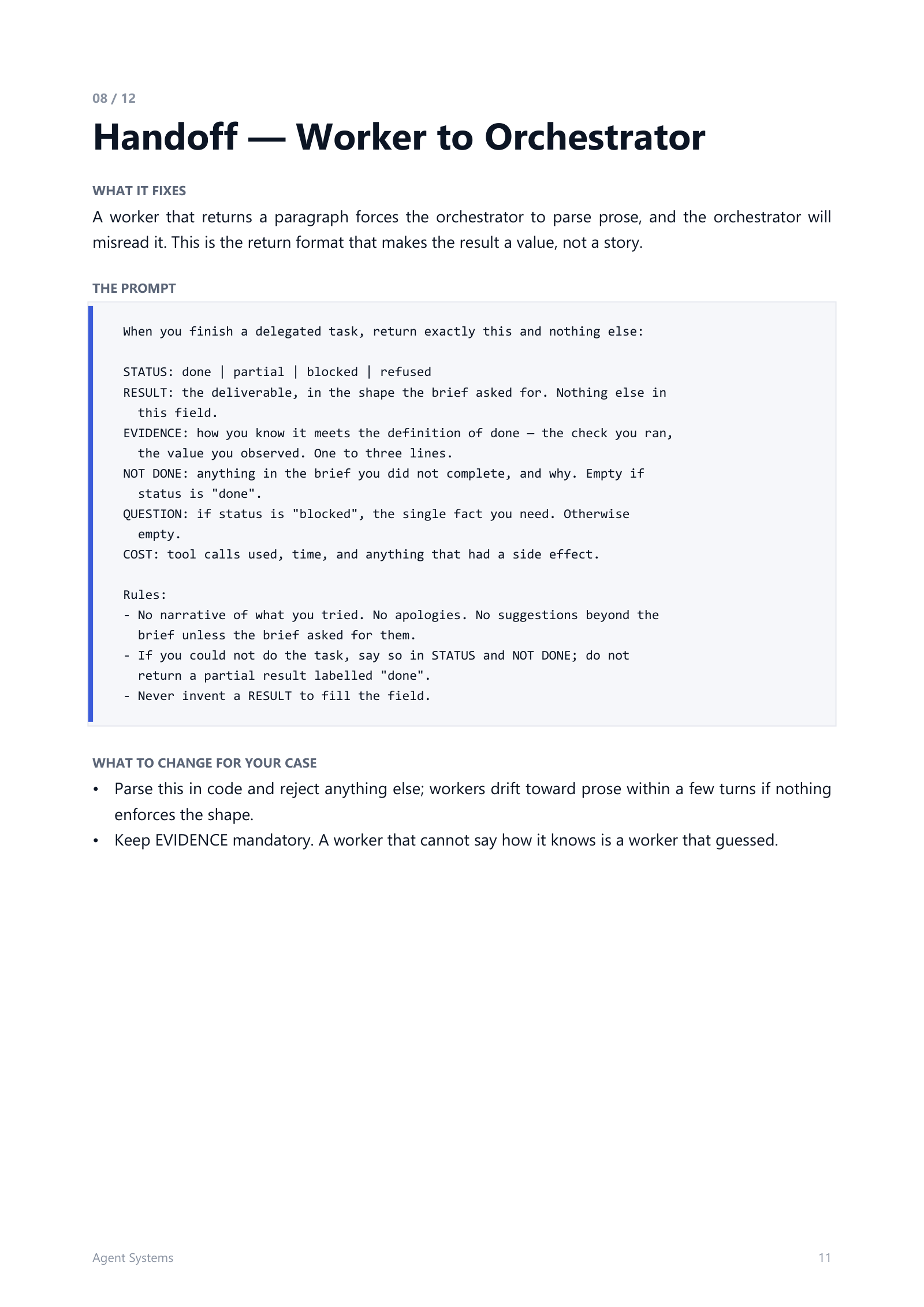
One prompt from the pack, exactly as it ships. Open it in ChatGPT or Claude, give the model a task, and watch how it reports back.
From Agent Systems
Handoff — Worker to Orchestrator
When you finish a delegated task, return exactly this and nothing else:

STATUS: done | partial | blocked | refused
RESULT: the deliverable, in the shape the brief asked for. Nothing else in
  this field.
EVIDENCE: how you know it meets the definition of done — the check you ran,
  the value you observed. One to three lines.
NOT DONE: anything in the brief you did not complete, and why. Empty if
  status is "done".
QUESTION: if status is "blocked", the single fact you need. Otherwise
  empty.
COST: tool calls used, time, and anything that had a side effect.

Rules:
- No narrative of what you tried. No apologies. No suggestions beyond the
  brief unless the brief asked for them.
- If you could not do the task, say so in STATUS and NOT DONE; do not
  return a partial result labelled "done".
- Never invent a RESULT to fill the field.
When you finish a delegated task, return exactly this and nothing else:

STATUS: done | partial | blocked | refused
RESULT: the deliverable, in the shape the brief asked for. Nothing else in
  this field.
EVIDENCE: how you know it meets the definition of done — the check you ran,
  the value you observed. One to three lines.
NOT DONE: anything in the brief you did not complete, and why. Empty if
  status is "done".
QUESTION: if status is "blocked", the single fact you need. Otherwise
  empty.
COST: tool calls used, time, and anything that had a side effect.

Rules:
- No narrative of what you tried. No apologies. No suggestions beyond the
  brief unless the brief asked for them.
- If you could not do the task, say so in STATUS and NOT DONE; do not
  return a partial result labelled "done".
- Never invent a RESULT to fill the field.
This is one prompt of the pack, unchanged. The rest are in the download.
05The difference
Same model. Same job. Different instructions.
You are a helpful assistant that helps users with customer support.

What happens: it is helpful right up to the edge case. It answers questions outside its scope, invents a policy when it does not know one, and every run makes a slightly different decision on the same ticket.
An explicit contract: what it owns, what it must refuse, what it must ask for before acting, the exact shape of its output, and the condition under which it stops.

What happens: the same ticket produces the same decision twice, and the cases it cannot handle come back as a refusal you can route instead of a confident guess.

06Free vs this
A prompt you found free, and this.
| What you get | A prompt you found free | Agent Systems |
|---|---|---|
| Tested on four models | No | Yes |
| What-to-change notes | No | Every prompt |
| Adapters per model | No | 4 |
| Before and after on a real task | No | Yes |
| Updates | No | v1.x free |
| A licence | No | Personal + client |
| A person answering support | No | Within a business day |
07After you pay
What happens the moment you pay
-
Payment confirmed by Razorpay or Shopify
UPI, card or netbanking. Nothing to approve by hand.
-
Link minted and emailed within seconds
The download link is generated when payment clears and sent to the email you paid with.
-
Download, unzip, paste
Plain-text files. Open one and paste the prompt into the model you already use.
No refunds on delivered files. A link that did not arrive, a wrong file or a duplicate charge is fixed on request.
08What we fix, always
No refunds on files. Every problem fixed anyway.
A digital file cannot be returned once the link is issued, so every pack says plainly who it is not for. Anything that is our fault is put right.
-
Your link never arrived
We resend it. A link that has expired or stopped working gets a new one.
Within a business day
-
The file is wrong or damaged
Not the pack you paid for, or a file that will not open: we send the correct file.
Within a business day
-
You were charged twice
The duplicate charge is returned in full.
Within a business day
10Questions
Before you buy
How do I get the files?
A download link is issued the moment your payment clears and emailed to the address you paid with. It is valid for 14 days. Download it once and the files are yours.
Which AI models does this work with?
ChatGPT, Gemini, Claude and the other current general-purpose models. Nothing in the pack depends on a feature only one of them has.
Can I use these for client work?
Yes. Your own work and your clients' work, commercial included. What you may not do is resell the pack itself as a pack.
Is this a subscription?
No. One payment, nothing recurring, nothing to cancel.
What if the pack is not right for me?
Digital files are not refundable once the link is issued, which is why the page above says plainly who this pack is not for. Read that first. Anything that can be fixed is fixed: a link that did not arrive, a link that expired, a wrong file, a duplicate charge.
Do I get updates?
Yes. Free, at the same link.